Tools · Free calculator
Position Size Calculator
Not financial advice. This tool does not recommend a stock, a position size, or a trade. It has no broker connection, no market data feed, and no order path. Most people who day trade lose money.
Use the paper account size, not a fantasy balance.
The share of the account you accept losing if the stop is hit. Many educational frameworks use a small single-digit percentage; this is not personal advice.
Entry minus planned stop. A $50 entry with a $47.50 stop has a $2.50 stop distance.
Suggested position
Fill in all four fields, then calculate. The result appears here without sending any data anywhere.
Not financial advice. This calculator is arithmetic for an educational plan. It has no broker connection, no market data, and no order path. It does not recommend a security, a position size, or a trade.
How the position size calculator works
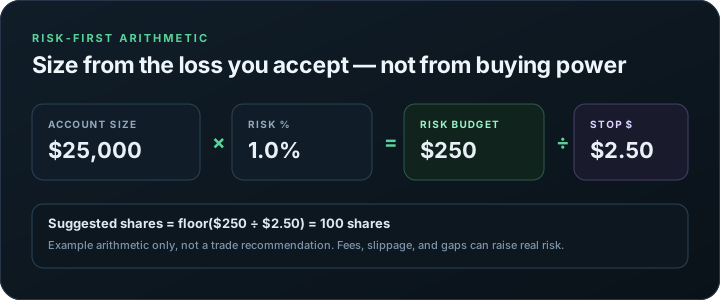
Position sizing starts with the loss you are prepared to accept, not with the number of shares you can afford. The calculator uses three steps. First, it converts the account size and risk percentage into a dollar risk budget. Second, it divides that budget by the stop distance to see how many whole shares would lose approximately that amount if the stop were reached. Third, it multiplies the share count by the entry price to show the notional position value.
suggested shares = floor(risk budget ÷ stop distance)
position value = suggested shares × entry price
For example, a $25,000 paper account with a 1% risk budget gives $250 of risk. If the planned entry is $50.00 and the stop is $47.50, the stop distance is $2.50 per share. Dividing $250 by $2.50 gives 100 shares, with a notional value of $5,000. That example is arithmetic only; it is not a recommendation to trade that stock or that size.
The calculator rounds down to whole shares. If the risk budget is too small to buy even one share at the chosen stop distance, it shows zero. Rounding up would quietly exceed the risk you entered, which defeats the purpose of sizing from a loss limit.
Why stop distance matters more than share price
A cheap stock is not automatically a small risk. If a $5 stock can move $1 against you, the stop distance is $1 per share, which is 20% of the entry price. A $100 stock with a $1 stop has the same dollar risk per share. Position size depends on the distance to invalidation, not on whether the quoted price looks low.
This is why the calculator asks for the stop distance rather than a vague “small stop.” A stop that is too tight may be hit by ordinary noise; a stop that is too wide may make the position impractically small. Both are planning questions. Paper sessions are the place to study how the instrument actually moves and how the simulation fills orders.
What the result does not include
- Fees and commissions. The calculator does not know your broker's charges, exchange fees, or data costs.
- Slippage and gaps. A stop is not a guarantee of the exit price. A fast market can fill beyond it.
- Liquidity. A large position in a thin instrument may be difficult to exit at the quoted price.
- Borrow and margin rules. Short selling, leverage, and pattern-day-trader requirements vary by broker and jurisdiction.
- Your personal situation. The tool has no idea whether risking that amount is appropriate for you.
Read the risk basics and the beginner pillar before treating a number as a plan. The how to start day trading roadmap explains where sizing fits in the wider process, and the risk-reward calculator helps you compare the planned loss with the planned target.
Compliance note. DayTraderSkill.com is not a broker, investment adviser, or signal service. This calculator does not execute trades and does not provide personalised advice. Paper trading remains the default.
Frequently asked questions
How does the position size calculator work?
It multiplies the account size by the risk percentage to get a dollar risk budget. It then divides that budget by the stop distance to estimate how many whole shares fit within the planned loss. Position value is the share count multiplied by the planned entry price.
Should I round the share count up or down?
The calculator rounds down. Rounding up would exceed the risk budget you entered. If the budget is smaller than one share of risk, the result is zero rather than a smaller-than-one-share position.
Does this calculator connect to my broker?
No. It runs entirely in your browser with no login, no market data feed, and no broker or order connection. It cannot place, modify, or close a trade.
Is the result a recommendation?
No. It is arithmetic based on the numbers you enter. It does not know your financial situation, the instrument, liquidity, fees, or whether the trade idea makes sense. It is not financial advice.
Why does position value exceed my account sometimes?
A small stop distance can imply a large share count. If the resulting notional value is above the account size, the position would require margin or leverage at many brokers. That adds risk and is not automatically appropriate for a learning account.