Practice
What is paper trading? Practice the workflow before real money
Not financial advice. A paper profit is not evidence that a strategy will work live. Most people who day trade lose money. Paper trading is a rehearsal, not a guarantee.
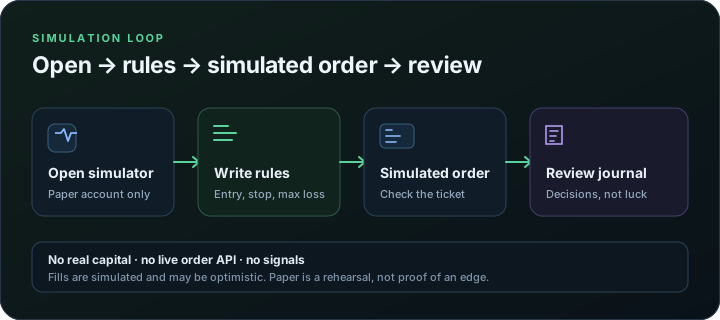
- Short first sessionOne instrument, one written rule, one reviewed decision.
- Checklist before the ticketConfirm paper mode, data timestamp, spread, and size.
- Keep the gate closedAny order-capable tool stays on Needs approval.
Paper trading: a plain-English definition
Paper trading is the practice of placing buy and sell orders in a simulated account. The platform records the orders and calculates a hypothetical profit or loss, but no real securities are exchanged and no real capital is at risk. It is sometimes called simulated trading or demo trading.
The quality of the simulation varies. Some paper accounts stream live market data and model fills conservatively. Others use delayed data, simplified fills, or assumptions that make execution look easier than it is. Before you trust a result, find out what the simulator is actually doing.
Why paper trading is the default here
Beginners make operational mistakes: wrong order type, wrong quantity, wrong ticker, wrong session, or a stop that was never actually placed. Paper trading lets those mistakes happen without a financial loss. That is valuable.
It also creates a low-pressure place to test whether you can follow a written process. You can practise the same checklist every session, journal the reason for each order, and review the decisions afterwards. Those habits transfer better than a lucky result.
Finally, paper trading separates learning from earning. You do not need to “make it back” in a simulator, and you do not need to force a trade to justify the time you spent. The goal is to learn the workflow, not to manufacture a streak.
What paper trading can and cannot teach
| Paper usually teaches | Paper often misses |
|---|---|
| Platform navigation and order entry. | Real fills when liquidity is thin. |
| The difference between order types. | Slippage during fast markets and gaps. |
| Following a written checklist. | The emotion of losing real money. |
| Journaling and reviewing decisions. | Broker rejections, halts, and operational failures. |
| Testing whether a process is understandable. | Whether a strategy has a durable edge after costs. |
The last point matters. A simulator can show a positive hypothetical result while ignoring the exact costs that make a high-frequency approach unworkable. Always ask what fees, spreads, and fill assumptions the platform applied.
How to start paper trading
- Choose a simulator or broker paper account. Use one that shows the order types, data, and market access you intend to study. Check whether the data is live or delayed.
- Set a realistic starting balance. A fantasy balance can encourage fantasy position sizes. Use an amount that would be meaningful but still entirely disposable in a learning context.
- Pick one instrument and one session. Write down what you are studying and when. Avoid jumping between markets before you can explain the first one.
- Write the process before the session. Include entry conditions, invalidation, position size, maximum loss, and a stop-trading rule. Keep it to one page.
- Use the same order types you would use live. If you plan to use limit orders, do not practise only with market orders. The mechanics should match the intended workflow.
- Journal every simulated order. Record the reason, the fill assumption, the outcome, and whether you followed the plan. Review the journal on a schedule.
A realistic first paper session
A useful first session is short. Open the platform, find the instrument, check the spread, place one small simulated order with a predefined invalidation, and close it according to your rule. Then write down what happened. Repeat the next day with the same process.
- Confirm you are in a paper account, not a live account.
- Check the data timestamp and the current spread.
- Place the order with the size written in your plan.
- Record the entry, exit, and reason in the journal.
- Review whether the process or the outcome drove your decisions.
Browser-only · no login · no market data
Paper session checklist and journal
Use this before and after a simulated session. Nothing here connects to a broker, fetches a quote, or places an order. Copy the template into your notes, or print the journal and write on it by hand.
First-session checklist
Journal rows
| Date | Plan / setup | Paper result | Notes / review | Row |
|---|---|---|---|---|
Paper only. A simulator can flatter a process: fills may be optimistic and costs may be simplified. Do not treat a good journal week as proof that live trading would work. Most people who day trade lose money.
Paper trading versus live trading
| Dimension | Paper trading | Live trading |
|---|---|---|
| Capital | Simulated; no real money at risk. | Real capital at risk. |
| Fills | Model-dependent; may be optimistic. | Subject to real liquidity and queue position. |
| Psychology | Lower stakes; easier to follow a plan. | Fear and greed can change behaviour. |
| Costs | May be simplified or ignored. | Commissions, fees, spreads, and slippage are real. |
| Operational risk | Limited; the simulator is not the market. | Rejections, outages, halts, and data failures matter. |
| Tax reporting | No real taxable transactions. | Depends on your jurisdiction and activity. |
Do not treat paper results as a forecast. A simulator can be a useful training tool and still produce results that would not survive live costs and execution. Paper is where you learn the questions to ask, not where you prove an edge.
Where software and AI tools fit
Paper trading is also the right place to test software that reads market data, drafts a plan, or prepares an order ticket. The useful question is not “can it place a trade?” but “can I see what it did, verify the inputs, and stop it before anything irreversible happens?”
If you use Claude skills or another agent workflow, keep the trading account on paper, keep brokerage tools on Needs approval, and require a human confirmation for any order path. The Claude skills install guide covers the general setup. The independent Day Trader Skill install guide covers one third-party pack; it is not the official project site.
Before connecting anything, read the safety checklist. It covers paper defaults, approval settings, secret handling, and the claims this site refuses to make.
Paper-first rule: if you cannot explain the ticket, do not approve it. “Needs approval” is a feature, not friction to remove.
Safety checklistFrequently asked questions
Is paper trading real trading?
No. Paper trading uses simulated orders and simulated capital. You may see real or delayed market prices, but the fills are not executed in the market and no real money changes hands.
Can paper trading make money?
Not real money. A paper account can show a simulated profit or loss, but that number does not mean you would have achieved the same result with live orders. Fill assumptions, slippage, and psychology can all differ.
Does paper trading prepare you for live trading?
It prepares you for the mechanics and the checklist, and it lets you make cheap mistakes. It does not fully prepare you for real slippage, liquidity, or the emotional weight of losing actual money. Treat it as practice, not proof.
What is a paper trading account?
It is a simulator, often offered by a broker or a third-party platform, that lets you place orders against a fake balance. Some accounts use live market data; others use delayed data or model fills.
Is paper trading free?
Many paper accounts are free, but some platforms require an account, charge for real-time data, or limit features. Check the current terms directly with the provider rather than relying on an old tutorial.
Should I go live after a winning paper streak?
There is no rule that a paper streak qualifies you for live trading. A short run can be luck, and simulated fills can flatter a strategy. This site does not tell you to trade live; that is a personal decision to make carefully, with professional advice if needed.
What is the difference between paper trading and backtesting?
Backtesting applies rules to historical data. Paper trading applies them forward, in a simulated account, as the market unfolds. Both have limitations, but they test different things.