Beginner pillar
Day trading for beginners: build skill before risking money
Not financial advice. This guide does not recommend a stock, strategy, or position size. It explains what to learn and how to practise. Day trading can lose money quickly, especially with leverage.
- Risk budget firstDecide the maximum loss before the entry.
- Size from the stopStop distance and risk percentage set the share count.
- Journal the decisionRecord why you acted, not only the result.
What day trading actually is
A day trade is a position opened and closed within the same trading day. The trader is trying to capture a move in price, usually with the intention of finishing flat before the market closes. That definition sounds simple. The execution is not.
Intraday prices are affected by spreads, order flow, liquidity, news, and the behaviour of other participants. A beginner is competing in a fast environment with people and systems that have more data, faster execution, and more experience. That does not make learning impossible. It does make humility a practical requirement.
Day trading is also not one activity. Scalping, momentum trading, mean reversion, and news-based trading are different approaches with different holding times and failure modes. Jumping between them before you understand one is a common way to learn very little.
What beginners need to learn first
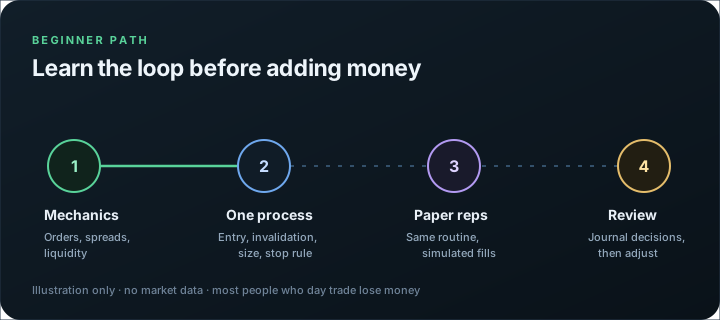
1. Market mechanics and order types
You should be able to explain the difference between a market order and a limit order, what a bid-ask spread is, and why a fill can be worse than the price you saw on screen. Learn what happens when liquidity disappears, when a stock is halted, and when an order is rejected.
These are not advanced topics. They are the cost structure of every trade. If you cannot explain them in plain language, a simulator is the right place to start.
2. One repeatable process
A process is more than an entry signal. It answers: what am I looking at, why might this setup be interesting, where is my invalidation, how large is the position, and when do I stop for the day? Writing those answers down before the session makes the decision easier to review afterwards.
You do not need a complicated system. A beginner-friendly process is usually short enough to fit on one page. If it requires twenty indicators and three chat groups to explain, it is probably not a process yet.
3. Risk and journaling
Risk is not just a stop-loss order. It includes position size, the distance to invalidation, slippage, concentration, and the possibility that your read is wrong. The journal is where you find out whether you actually followed the plan or only described it well.
Read the risk basics before you think about live capital. The position size calculator turns a risk percentage and stop distance into a share count, and the paper trading guide explains how to rehearse the whole loop without risking money.
A paper-first path for beginners in the first month
This is an educational sequence, not a performance plan. Move at the speed that lets you explain what you are doing. The goal is not to “graduate” to live trading on a schedule.
- Week 1 — Learn the vocabulary. Read the definition of day trading, learn order types, and open a simulator. Place a few test orders and watch how they fill.
- Week 2 — Pick one market and one session. Study a single instrument and a single time window. Write down the hours, the data source, and the conditions you will ignore. Narrow beats broad when you are learning.
- Week 3 — Write a one-page plan. Define entry conditions, invalidation, position sizing, maximum daily loss, and a stop-trading rule. Then follow it on paper for several sessions.
- Week 4 — Journal and review. Record the reason for each simulated order, the result, and whether you followed the plan. Look for repeated mistakes rather than a single lucky outcome.
- Repeat before adding complexity. If the process is not clear on paper, adding more indicators or a live account will not fix it.
The how to start day trading roadmap expands each step and includes a pre-flight checklist.
The costs that do not appear in the headline
Beginners often calculate a trade using the entry and exit price and forget everything in between. Those frictions matter, especially when you trade frequently.
| Cost or friction | What it means | Why beginners miss it |
|---|---|---|
| Bid-ask spread | The gap between the best buy and sell price you can trade against. | It looks small per share but adds up across many trades. |
| Commissions and fees | Broker, exchange, regulatory, and platform charges. | “Commission-free” does not always mean zero cost. |
| Slippage | The difference between the expected price and the fill you get. | Fast markets and thin liquidity can move the price before your order fills. |
| Data and tools | Real-time data, scanners, charting, and news subscriptions. | Free data may be delayed, incomplete, or rate-limited. |
| Taxes and record-keeping | Frequent trading can create complex reporting and short-term gains. | Tax treatment depends on your jurisdiction and personal situation. |
| Opportunity cost | Time spent watching screens instead of other work or study. | The learning curve is real even when no money is lost. |
Common beginner mistakes
- Going live too early. A simulator is not perfect, but it is a cheaper place to discover that you do not yet have a process.
- Oversizing to “make it worthwhile.” A position that can hurt you badly makes it harder to follow any plan, even a good one.
- Revenge trading. Trying to win back a loss immediately usually increases size and reduces judgment.
- Indicator hopping. Adding tools can feel like progress while avoiding the harder work of testing a process.
- Following signals. A call to buy or sell is not education, and it does not transfer the reasoning or the risk.
- Judging a strategy on one day. A single outcome says very little. Review a series of decisions and the conditions around them.
How much money should a beginner risk?
This site does not give personal position sizing or tell you to trade live. A useful educational principle is that speculative trading should use only money you can afford to lose entirely, and that leverage magnifies both gains and losses. That is not a recommendation for your situation. If the amount keeps you awake, it is too large for a learning process.
Many beginners would benefit from treating live trading as a later, separate decision — or not making it at all. Paper trading exists so that the decision is not forced by a desire to “make back” the cost of a course or a data subscription.
Your first-session checklist
- I can explain the order types I plan to use.
- I know the session hours and the instrument I am studying.
- I have written my entry, invalidation, and maximum loss.
- I am on a paper account, not a live one.
- I will journal the reason for each simulated order.
- I will stop when my written stop-trading rule is hit.
- I will review the session before changing the plan.
Compliance note. DayTraderSkill.com does not provide investment advice, stock picks, signals, or trade execution. Most people who day trade lose money. If you need personal advice, speak to a licensed professional in your jurisdiction.
Frequently asked questions
How long does it take to learn day trading?
There is no fixed timeline, and no honest guide can promise one. The useful milestone is whether you can explain your process, follow it on paper, and review your decisions without hiding mistakes. That takes repeated practice, not a weekend course.
Can I learn day trading without risking real money?
You can learn a great deal with a paper account: platform mechanics, order types, checklist discipline, and journaling. Paper trading cannot reproduce real slippage, liquidity, or the emotion of losing actual money, so it is preparation rather than proof.
How much money do I need to start day trading?
There is no universal amount, and this site does not give personal financial advice. A responsible starting point is that live trading is optional and should not involve money you cannot afford to lose entirely. Ask a licensed professional about your own situation.
What should a beginner study first?
Start with market mechanics: what a day trade is, how bid-ask spreads and order types work, what liquidity means, and how position size determines risk. Then write a simple process and rehearse it on paper before adding complexity.
Do I need a paid course or a signal group?
No. Free documentation, exchange education pages, broker demos, and books can teach the mechanics. A signal group that tells you what to buy is not education, and this site does not endorse or sell one.
Is day trading the same as investing?
No. Day trading attempts to capture intraday price movement and usually closes positions before the session ends. Investing typically holds assets for years and focuses on business or portfolio ownership. They involve different time horizons, costs, and risks.