Definition
What is day trading? A plain-English definition
Not financial advice. This is a definition and risk explainer, not a recommendation to trade. Day trading can lose money quickly, especially when leverage is involved.
- Same sessionA day trade is normally opened and closed before the close.
- Practice the mechanicsSimulated orders show how the workflow feels before real money.
- Know the downsideLeverage and frequent trading can amplify losses.
The definition
Day trading is the buying and selling of a financial instrument within a single trading session, with the intention of closing the position before the session ends. The trader may be long (betting on a rise), short (betting on a fall, where the broker permits it), or trading a related instrument. The common thread is the intraday holding period.
A day trade is defined by when it is opened and closed, not by how many trades someone makes or how fast they click. A position opened and closed in the same session is a day trade even if it was held for several hours. A position opened today and closed tomorrow is not.
What counts as day trading?
| Activity | Day trade? | Why |
|---|---|---|
| Buy and sell the same stock before the close. | Yes | The position is opened and closed within the session. |
| Short a stock in the morning and cover before the close. | Yes, if permitted | Same-day entry and exit; short-selling rules vary. |
| Buy today and sell next week. | No | That is a swing or longer-term position. |
| Buy and hold for years. | No | That is investing, with a different time horizon. |
| Trade a futures or forex contract intraday. | Often treated as day trading | Different markets and rules; verify with the venue and broker. |
How an intraday trade works — an illustrative example
Suppose a stock is quoted at $50.00 bid and $50.02 ask. A buyer using a market order might pay $50.02, while a seller might receive $50.00. The $0.02 gap is the spread, and it is a cost before any commission or fee.
If the price later moves so that the bid is $50.12 and the ask is $50.14, the trader sells at the $50.12 bid. The gross result is $0.10 per share before fees and taxes. The spread is already embedded in that number: the buyer paid the ask and sold at the bid. Measured mid-to-mid, the market moved about $0.12 while the trader captured about $0.10. If the price falls instead, the loss is real. This arithmetic is illustrative only; it is not a trade idea or a promise.
The example also shows why execution matters. A wider spread, a slower fill, or a sudden price jump can change the result. A backtest or paper fill that ignores those details can make an idea look better than it is.
Day trading versus swing trading versus investing
| Dimension | Day trading | Swing trading | Investing |
|---|---|---|---|
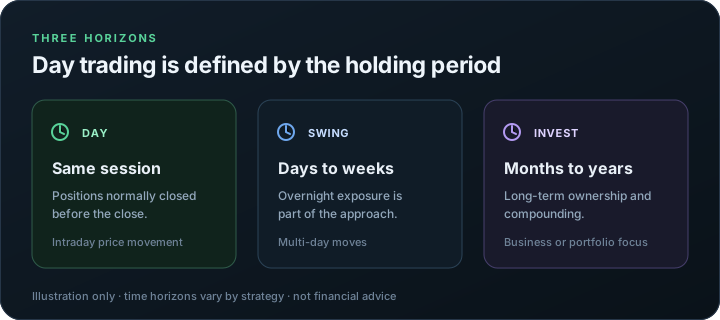
| Typical holding period | Minutes to hours, closed same day | Days to weeks | Months to years |
| Primary focus | Intraday price movement | Multi-day moves | Long-term ownership and compounding |
| Overnight risk | Usually avoided | Yes | Yes |
| Cost sensitivity | High; frequent spreads and fees | Moderate | Lower for a buy-and-hold approach |
| Time commitment | Often intense during the session | Periodic monitoring | Periodic review |
Why day trading is difficult
- Costs compound. Spreads, fees, and slippage apply to every round trip. A strategy that looks profitable before costs may not survive them.
- Competition is professional. Other participants may have faster data, lower costs, and more experience. A beginner should assume they are at a disadvantage.
- Leverage cuts both ways. It can magnify gains and losses. A small adverse move can become a large account loss.
- Psychology is part of the system. Fear, greed, and the urge to win back a loss can override a plan. That is why written rules and a journal matter.
- Short samples mislead. A few wins or losses say little about a process. Reviewing a series of decisions is more useful than celebrating one day.
Rules and account requirements
Day trading is regulated differently across jurisdictions, and brokers add their own requirements. Pattern-day-trader rules, margin requirements, settlement, short-selling restrictions, and tax treatment can all change. Some brokers require specific account types or minimum balances for certain activity.
Do not rely on an old blog post or a social media screenshot for the current rule. Check the broker’s current disclosure documents and the relevant regulator. This site is not a legal, tax, or compliance adviser.
Is day trading gambling?
Day trading involves genuine financial risk, and it can resemble gambling when someone trades without a process, oversizes, or chases losses. Having a plan does not remove the risk or guarantee an edge. The distinction is not a label that makes the activity safe; it is whether decisions are made with defined risk and reviewed honestly.
Where to go next
If you are new, continue with day trading for beginners for the broader learning path, or read how to start day trading for the step-by-step version. Before any live decision, read the safety and risk checklist and practise in a paper account. If you are testing a written plan, the position size calculator makes the distance from entry to invalidation visible in dollars.
Compliance note. No stock picks, signals, profit promises, or trade-on-your-behalf service. Most people who day trade lose money. Nothing here is financial, legal, or tax advice.
Frequently asked questions
What is day trading in simple terms?
Day trading is buying and selling a financial instrument within the same trading day, usually to profit from short-term price changes. The position is normally closed before the session ends, so the trader is not exposed overnight.
Is day trading the same as swing trading?
No. Swing trading holds positions for days or weeks to capture a larger move. Day trading closes within the session. The holding period changes costs, overnight risk, and the amount of screen time involved.
Is day trading investing?
Not in the usual sense. Investing typically focuses on owning assets for the long term. Day trading focuses on short-term price movement. They use different time horizons, risk controls, and measures of success.
Can you day trade with a small account?
Account rules and minimums vary by broker and jurisdiction. This site does not tell you what account size is appropriate. What matters educationally is that leverage and frequent trading can amplify losses, and no account size makes a weak process safe.
Do day traders make money?
Some do, and most retail day traders lose money after costs. A few winning trades do not prove skill, and no guide can promise a result. The risk of loss is real and can be rapid, especially with leverage.
Is day trading legal?
It is permitted in many jurisdictions, but rules vary and can change. Brokers impose their own account, margin, and pattern-day-trader requirements. This is not legal advice; verify the current rules where you live and with your broker.
Does day trading require special software?
You need a broker or simulator, market data, and a way to record your decisions. A complex tool stack is optional. For learning, a paper account and a journal are more useful than a large collection of indicators.